
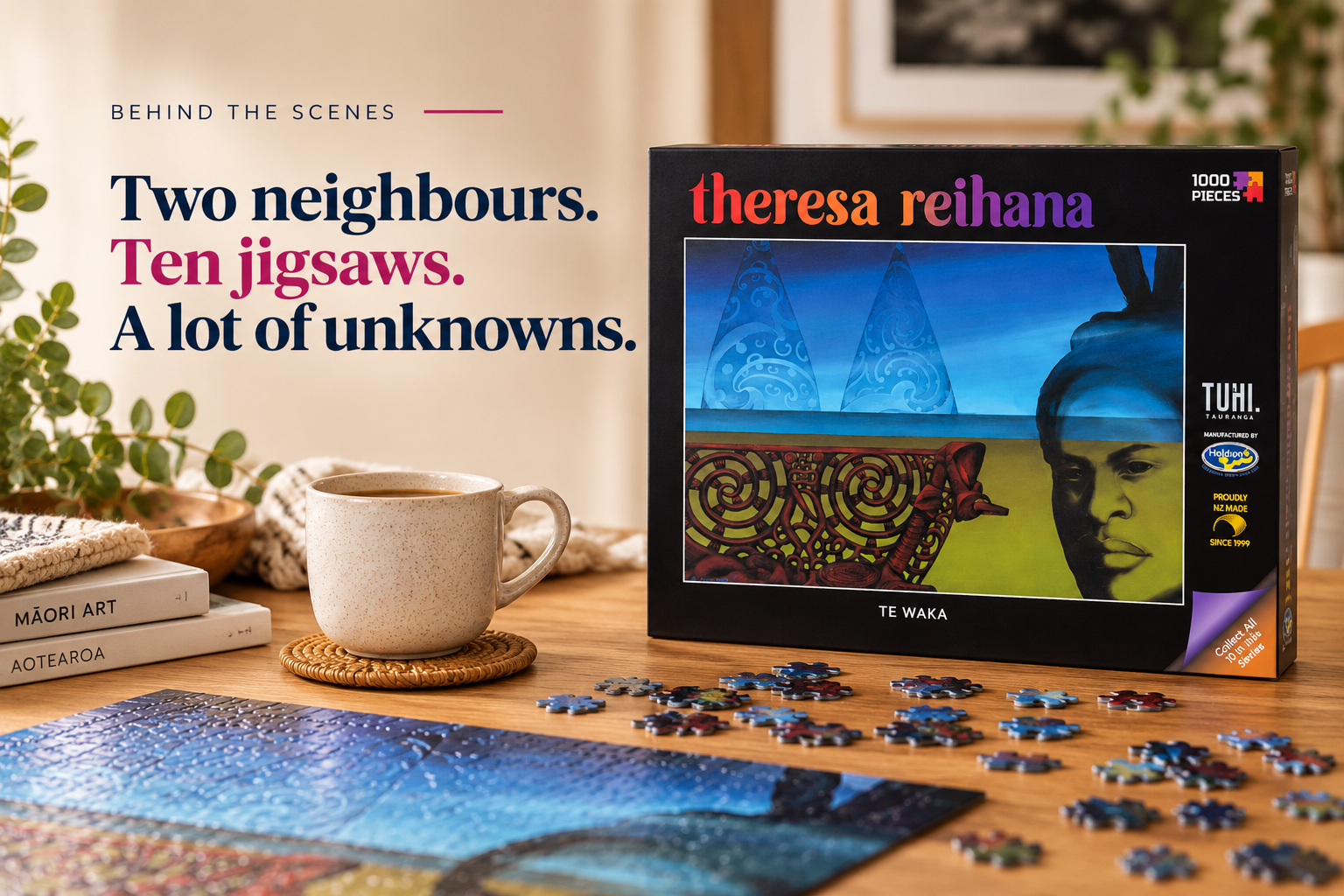
Theresa Reihana and I have been neighbours for over 30 years. A couple of years ago, we sat down together to talk about whether there was a way to work together — to get her art in front of more people, and bring something new to Tuhi's range. Neither of us really knew what that would look like. We talked through a few ideas before landing on jigsaws: 1000-piece puzzles featuring her artwork. It felt like a good place to start — something tangible, something neither of us had tried before, and a way to test whether there was an audience for her work in a completely different format.
We made the first four jigsaws over 18 months ago. The remaining six have only just been completed — and the gap between those two milestones says a lot about what this kind of partnership actually involves.
Part of the delay came down to packaging. The first four jigsaws went out in larger boxes, which we hadn't fully costed for shipping — particularly for orders heading overseas. For this second batch of six, we've moved to smaller boxes: easier and cheaper to ship around the country and internationally, and sized to fit inside larger gift boxes too as we had many requests for gift sets from customers and retailers. Small change, but one we only learned by doing the first run.
The bigger factor was our printer. We use Holdsons, a local manufacturer — and when they ran into machinery problems last year, we made a deliberate choice to wait for them to be ready again rather than source overseas. That's not the fastest or cheapest way to bring a product to market. But sourcing locally, and using original artwork by a Māori artist, are part of what this partnership is actually about — not just for us, but for what we're trying to build with Theresa. We're not sure if we'll always make that call, but for this collection, it mattered.
Once we had the jigsaws underway, we started testing the artwork in other formats — first as a single image on a diary cover, then expanded into journals, now with four of Theresa's images across our journal range. Each step has been its own small test: does this work as a jigsaw? Does it work as a journal cover? What do people actually respond to?
It was also a safer risk for us to use part of Theresa's existing catalogue for this first collection. That meant some of these images were genuinely challenging as jigsaws — even for dedicated puzzlers — but I couldn't ask Theresa to paint a new series specifically designed for jigsaws until we had some proof of concept first.
Which gets to the part that doesn't usually get talked about. As a small Māori business, there's no fund or programme that de-risks this kind of testing for you. No grant for "let's see if this idea works." You're testing with your own money, your own time, and your customers' willingness to take a chance on something new — one format, one print run, one collection at a time.
That's reflected in the price. Our jigsaws are $65, compared to $45-$55 for similar sized puzzles elsewhere. That gap isn't margin for the sake of it. It's what it costs to produce a smaller run, locally, with an artist — without the economies of scale bigger producers have. Our jigsaws take time, and the end result is something you will want to frame and display.
The Bigger Thing I've Been Thinking About
Everyone loves to "collab" with pakihi Māori. Far fewer want to actually partner. There's a difference. Collaboration is low-risk, low-commitment — good for a press release. Partnership means shared risk, shared reward, and showing up when it's not clear yet whether something is going to work.
Theresa and I have made our share of mistakes along the way, and we're still learning. But the principle holds at any scale. Not every artist wants to run a business — and many business owners already have the customers, the platform, and the relationships that could open doors for others, if they're willing to share some of the risk involved.
I've seen this work at the smallest possible scale — one business, one artist, figuring it out as we go. I've also seen it work inside a much larger organisation. When I was CEO at an iwi, we had a small space near reception displaying local artists' work. Council staff, government agencies, developers, consultants, community members — almost everyone who came through stopped and bought something on their way out. Minimal cost to the iwi. Real income for the artists. No fund, no programme — just someone willing to make the space available.
Most of us are probably already sitting in roles, or have spaces and platforms, that could do something similar — if we thought about it.
The first four jigsaws in this collection are in stock now. Pre-orders for the remaining six are open today, arriving 1 July — just in time for Matariki.